
5 Types of Machine Learning Explained Simply
Confused by ML terminology? Learn the 5 core types of machine learning — supervised, unsupervised, reinforcement & more — with real examples in 3 minutes.
Types of Machine Learning: A Practical Guide
Most Machine Learning explanations either drown you in math or oversimplify so much you can’t use what you learned. This is the middle ground — enough technical grounding to know why each type works, enough real-world framing to know when to use it.
A Quick Analogy
Teaching a child to recognize fruit at the grocery store:
- Supervised learning — showing them labeled pictures of apples and bananas until they recognize new ones.
- Unsupervised learning — handing them an unlabeled fruit basket and letting them notice round red things cluster apart from long yellow things.
- Reinforcement learning — letting them taste fruit and learn from the reaction: sweet means “good,” sour means “try again.”
Every ML system you use — Netflix recommendations, spam filters, ChatGPT — runs on some combination of these.
1. Supervised Learning — Learning From Labeled Examples
Core idea: You train a model on data where every input already has a known correct output (a label). The model learns the mapping x → y well enough to predict y for new inputs.
Two flavors: classification (predicting a category — spam or not spam) and regression (predicting a number — what will this house sell for).
Real uses: spam filters, fraud detection, medical imaging that flags tumors, price prediction.
The catch: It’s only as good as its labels, and labeling data is expensive and slow — the exact limitation that pushed research toward the next category.
2. Unsupervised Learning — Finding Structure Without Answers
Core idea: No labels at all. The model looks for inherent structure or relationships in the data itself, through clustering (grouping similar points) or dimensionality reduction (simplifying complex data while keeping its meaning).
Real uses: customer segmentation, “frequently bought together” recommendations, anomaly detection in cybersecurity.
The mindset shift: supervised learning confirms what you already suspect; unsupervised learning tells you something you didn’t know to look for.
3. Reinforcement Learning — Learning Through Trial, Error, and Reward
Core idea: An agent takes actions in an environment, observes the resulting state, and gets a reward or penalty. Over many rounds, it learns a policy — a strategy that maximizes cumulative reward.
Unlike the first two, there’s no fixed dataset — the model generates its own experience by acting and observing consequences.
Real uses: game-playing AI (Chess, Go, Atari), self-driving cars, robotics, and the try-evaluate-adjust loop behind today’s AI agents.
4. Semi-Supervised Learning — A Little Labeled, A Lot Unlabeled
A practical compromise: a small labeled dataset plus a large unlabeled pool. The model uses the labeled portion to make educated guesses about the rest, learning from both.
Real uses: medical imaging (expert labels are scarce, raw scans aren’t), large-scale text classification — anywhere labels are costly but data is abundant.
5. Self-Supervised Learning — The Model Quizzes Itself
The quiet workhorse behind today’s biggest AI systems. The model generates its own labels from raw data — hiding part of a sentence and predicting the missing word, for example.
This is why large language models can train on enormous volumes of internet text without anyone manually labeling it.
How They Actually Combine
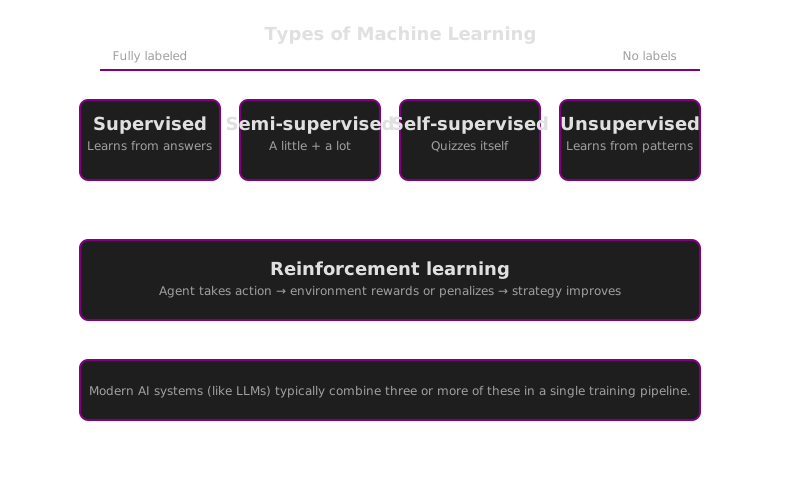
Modern AI rarely uses just one type. A large language model typically pretrains with self-supervised learning on raw text, gets sharpened through supervised fine-tuning, and has its behavior shaped through reinforcement learning — three types, one system. Multimodal models (text + image + audio) follow the same layered pattern.
Don’t think of these as five competing options. Think of them as tools that increasingly get combined.
Quick-Pick Cheat Sheet
| Your situation | Likely fit |
|---|---|
| Labeled historical data, clear outcome to predict | Supervised |
| Unlabeled data, want hidden patterns or groups | Unsupervised |
| Optimizing a sequence of decisions with feedback | Reinforcement |
| A little labeled data, lots of unlabeled data | Semi-supervised |
| Massive raw, unlabeled data (text/image/audio) | Self-supervised |
Why This Matters
If you’re evaluating an AI vendor, scoping a product feature, or just learning, this framework helps you:
- Ask sharper questions — labeled vs. unlabeled data needs tell you a lot about project cost.
- Set realistic expectations — reinforcement learning needs a simulatable environment; it’s not a fit everywhere.
- Spot oversold claims — “zero data prep needed” deserves a follow-up question.
Bottom line: Supervised learns from answers, unsupervised learns from patterns, reinforcement learns from consequences — and the most powerful AI today knows how to use all three at once.